
Searching Lake County Court Docket
Minnesota Court Records Online, or MCRO is the main remote tool for a Lake County case lookup. Name searches, case-number searches, citation-number searches, and attorney searches all work there. A court file number is the fastest route to a Lake County result. Without one, choose Lake as the county and set the right category. Then check that more than a name matches. Eligible public results open a Case Details view. Minnesota calls it the Register of Actions.
Lake County Court Administration handles what MCRO cannot. Confirm a result, get an unavailable document, or order a certified copy there. Remote results can be incomplete, delayed, or blocked by an access rule. The courthouse terminal and the court counter belong in the Lake County record path from the start. They are not last resorts.
- Open the official MCRO Case Search and choose a name, case number, citation number, or attorney search.
- For a name search, select Lake County and compare the category, filed date, party role, and court location.
- Open the eligible result to read its Register of Actions, public events, settings, and available documents.
- Use the Hearing Search or Lake County daily calendar when the immediate question is a setting rather than case history.
- Ask Lake County Court Administration for a broader public view or a plain, certified, or exemplified copy.
Note: MCRO is an unofficial public search service, so Lake County Court Administration supplies the official record or a certified copy.
Lake County MCRO Search Paths
Pick the narrowest MCRO tool for your question. Case Search fits a party or file. Document Search works best case-number first. Hearing Search filters by party, file, judicial officer, attorney, date, category, and Lake County location. Judgment Search covers docketed money judgments and satisfactions, not every civil matter. Keeping these paths straight stops a hearing lookup from being mistaken for a complete Lake County court docket search.
The MCRO overview explains that public documents may be free of charge when access rules allow. A known case number sharpens that route. For a federal case, MCRO is the wrong system. Use PACER or the District of Minnesota.
The official MCRO overview lays out the separate public search and document-access paths.
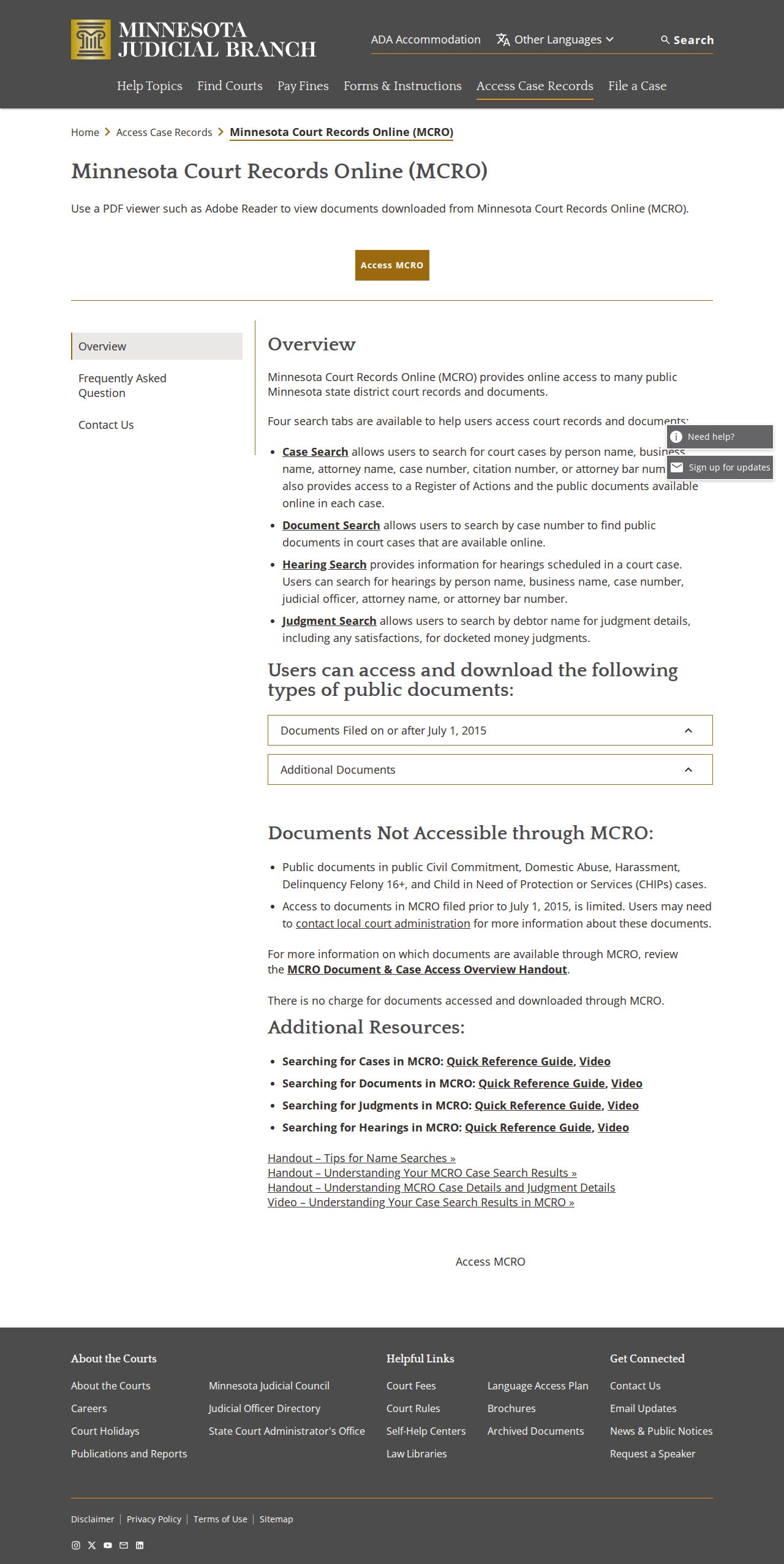
That distinction matters in Lake County. A case lookup, document request, hearing search, and judgment search each answer a different question.
Inside a Lake County Court Docket
Think of a Lake County Register of Actions as the procedural spine of a Minnesota case. It can show the court file, case category, parties, events, filings, scheduled hearings, judicial officer, orders, judgment, disposition, and fee information. An entry is short, though. It is not the full order or transcript. A listed charge remains an allegation until the case record shows a result. A setting alone does not prove a hearing occurred.
| Case number | The court-assigned link among Lake County filings, hearings, and copy requests. Observed formats include 16-CR-26-95 and 16-VB-26-95. |
|---|---|
| Case category | A broad grouping such as Civil, Criminal, Family, Probate, or Mental Health. |
| Filed date | The date a case or filing reached the court record. It may differ from the event date. |
| Hearing | A scheduled proceeding with a date, time, location, and type. It is not a result. |
| Order or judgment | A court action that should be read with the public document or certified copy when details matter. |
| Disposition | A recorded resolution or status. It is not interchangeable with a verdict in every case. |
What a Lake County docket description leaves out can matter. Facts, reasons, later changes, and attached papers may all be missing. Keep the exact case number and document title handy before contacting Court Administration, so a Lake County request stays specific without sending sensitive data in an open message.
Lake Courthouse Terminal Access
Lake County District Court confirms a public-access court-record computer at the courthouse. Minnesota’s statewide access explanation covers courthouse terminals. It notes they can show a more complete public view than remote access. Some local paper records also require counter access. A missing MCRO result is not the last word. It does not prove that a Lake County case or document does not exist.
The courthouse sits at 601 Third Avenue in Two Harbors. Lake County Court Administration posts regular weekday hours. A local telephone route and a physical access point for records and certified copies are also listed there. Bring the case number, party name, or year when known. Staff can explain access procedures. But they cannot give legal advice or decide the merits of a case.
Minnesota’s Access Case Records page describes remote access, courthouse terminals, and local record paths.
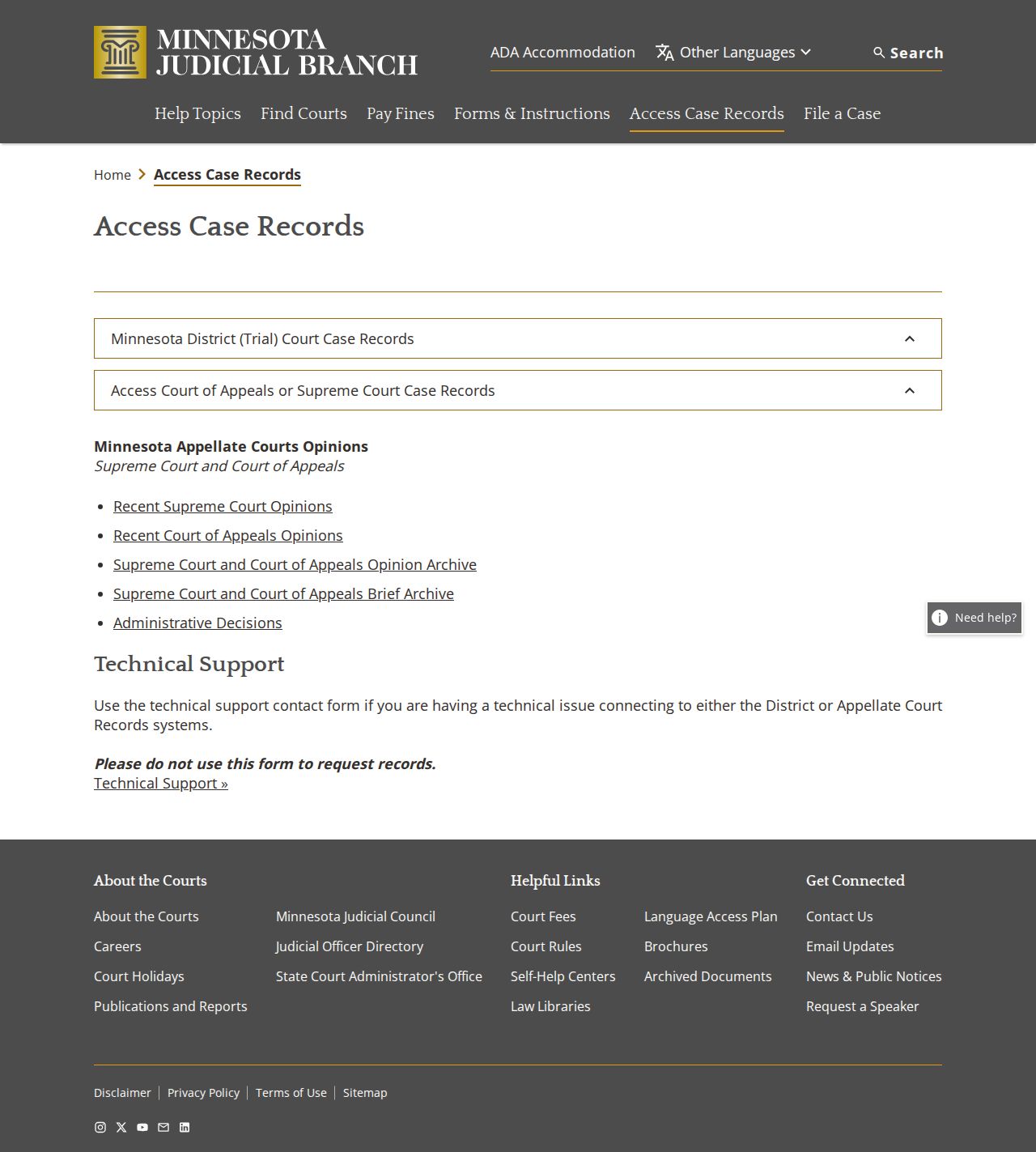
For Lake County, the public terminal is a complementary access channel. It helps most when the online Register of Actions runs into limits.
Courts That Keep Dockets in Lake County
Lake County cases start in Minnesota District Court, specifically Lake County District Court. That court has original jurisdiction. It covers civil, family, probate, juvenile, criminal, traffic, and related court-filed matters. No separate trial court is listed for Lake County. There is no county superior court, justice court, or municipal docket. The Sixth Judicial District serves Carlton, Cook, Lake, and St. Louis Counties. Its administration cannot replace Lake County Court Administration for a local file.
| Court or record source | Lake County matters covered | Where to search or request |
|---|---|---|
| Lake County District Court | Civil, criminal, family, probate, juvenile, traffic, conciliation, and local ordinance cases filed as court matters. | MCRO, the courthouse terminal, or Lake County Court Administration. |
| Minnesota Court of Appeals | Review of a district-court decision when an appeal is taken. | The appellate court’s official sources after identifying the district-court case. |
| Federal courts | Federal civil, criminal, bankruptcy, and appellate matters. | PACER and the relevant federal court, not MCRO. |
The Sixth Judicial District page names the four counties in Lake County’s administrative district.
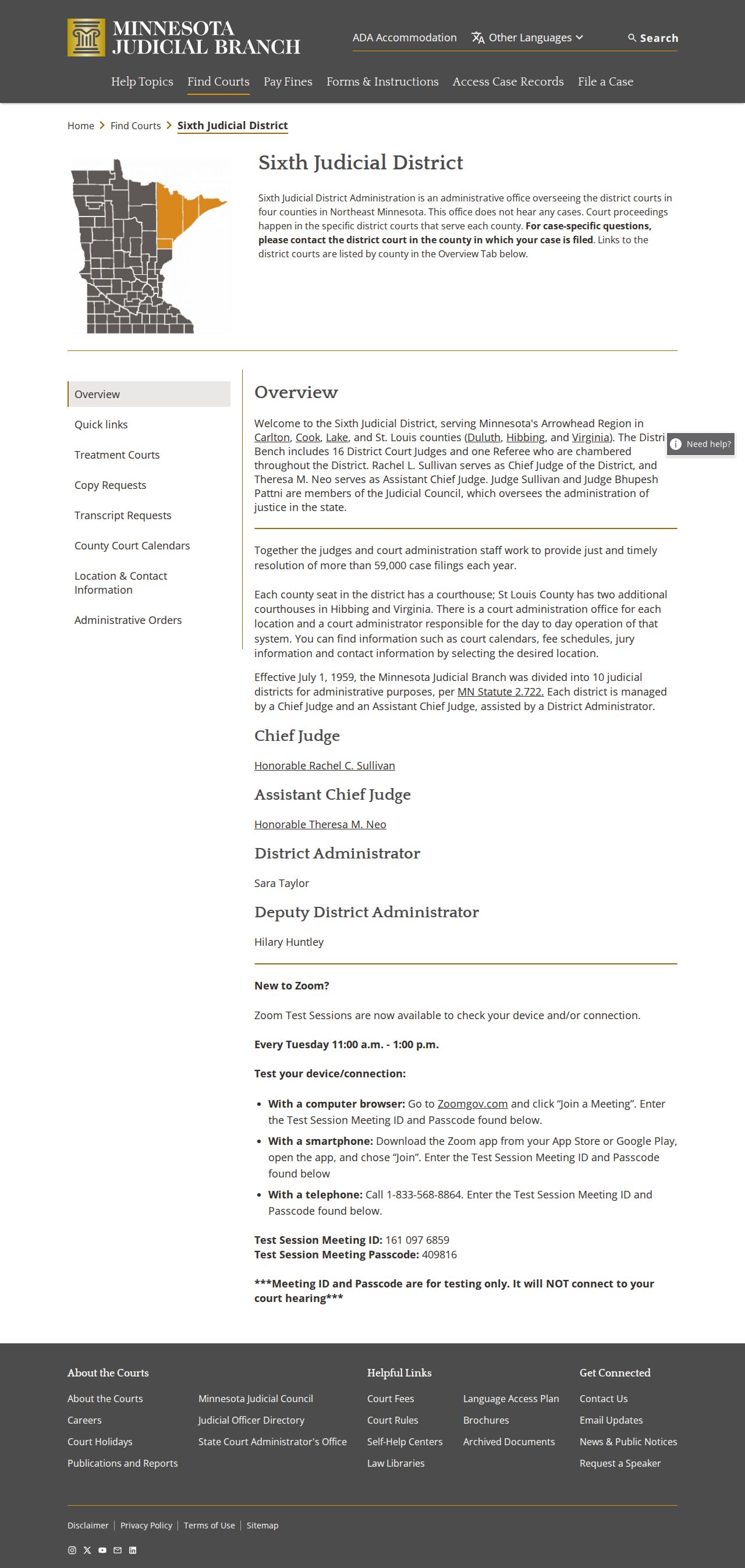
The Sixth District sets the administrative frame. Lake County Court Administration stays the local source for a Lake County file.
City code enforcement can be a city administrative matter. A city website or ordinance page is not proof of a separate Lake County court docket. Read the ticket or notice. Use the state court path only when the matter was filed with the district court.
Lake County Calendar Timing
For a same-day look at Lake County hearings, the Lake County daily calendar is the place to start. It posts at 7:00 a.m. every business day. The court refreshes it hourly. Each line packs in details. It can carry a party name, the hearing location, the date and time, the judicial officer, the hearing type, the connection type, and the case number. Common hearing labels on the docket include First Appearance, Arraignment, Pre-trial, Omnibus Hearing, Motion Hearing, and Initial Case Management Conference.
Keep the calendar's limits in mind. It lists settings only. The Register of Actions is the chronological case history, and it tells a different story. The online PDF may leave out confidential matters or ones unfit for remote viewing. A missing line does not prove a hearing was cancelled. The printed lobby or courtroom calendar stays the most current local source. Court Administration can confirm any material change. The Lake court page carries the official calendar warning along with its access details.
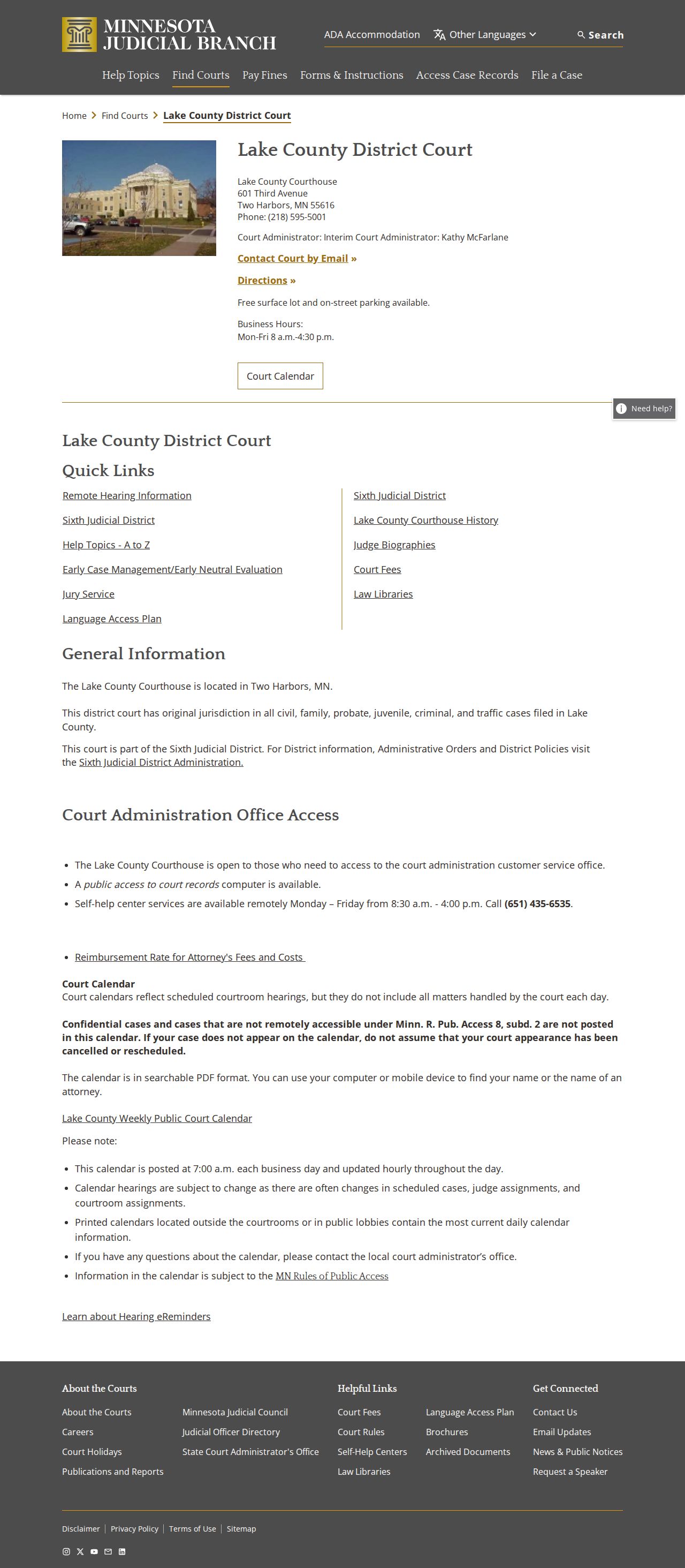
Timing matters with a Lake County calendar. Note when you checked it, then check again the morning of the hearing.
How to Find Court Dates and Settings
MCRO Hearing Search works best with a name, case number, judicial officer, attorney, or date range tied to a Lake County hearing. The daily calendar suits a session-by-session public schedule. Neither one promises that a setting will happen as listed. Hearings get continued, cancelled, reassigned, or kept off remote display. If your appearance matters, call Lake County Court Administration with the case number in hand.
A Remote Hearing label names the connection type. It guarantees nothing about public participation, recording rights, or confidential portions. For connection instructions, the Judicial Branch's remote-hearings information is the official starting point. Eligible parties can sign up for text or email eReminders. But an eReminder is never official notice. A Lake County calendar entry is a setting, not a result. So verify any continuance or attendance question with Court Administration.
Lake County Case Code Basics
Lake County dockets run on Minnesota's MNCIS and MCRO structure. The codes are simple once you know them. CR marks a criminal case. VB marks a payable traffic case. CV marks a civil case, FA a family case, and JV a juvenile case. Treat them as search clues only. They are not a complete Lake County codebook and not a legal conclusion. Also note that a citation number differs from the later MNCIS court file number.
- Register of Actions
- The dated procedural history of a Lake County case, including its activities, proceedings, and filings.
- Continuance or reset
- A change to a scheduled setting. It does not show why the date moved.
- Disposition
- The recorded case or charge result, which must be read in its actual context.
- Certified copy
- A copy authenticated by Lake County Court Administration as a true court record.
Which number should you use? For a traffic citation, the preprinted citation number may be the fastest way in. For a public document, the Lake County court file number usually works better. Never read an outcome into the first numeric segment or a code alone.
Public Access to Court Dockets
Minnesota's Rules of Public Access govern Lake County court records. It is not a simple county-records request model. Minnesota Statutes section 13.90 puts judicial records under the Supreme Court's rules. Rule 8 allows public inspection and copying of accessible records while setting remote-access limits. So a Lake County record can be open at the courthouse. Yet that same record may be unsearchable by name through MCRO.
Key rules for Lake County access:
Minnesota Statutes section 13.90 places judicial-branch records under the court-access rules rather than the general Data Practices Act.
Rule 8 sets the basic access principle and remote restrictions for court records.
Rule 4 governs restrictions ordered by a court and distinguishes the official transcript from supporting recordings.
What stays protected? Social Security and employer ID numbers, addresses, phone numbers, and financial-account data, plus identifying details on jurors, witnesses, or victims. Some pending criminal, traffic, and petty-misdemeanor matters face limited remote name search. Orders for protection, harassment, child-protection, juvenile, family, and other sensitive matters each carry their own access boundaries.
Lake County Court File Requests
The Sixth District copy-request form gathers your basic details. It asks for your contact information, the Lake County location, a file number or year, party names, a document description, the copy type, quantity, and a delivery choice. Delivery runs by U.S. mail, Lake County pickup in Two Harbors, fax, or email. Email works only for plain, non-confidential copies, and payment comes before processing.
Fees are on the Lake fee page. A plain uncertified copy, printout, scan, or screen print lists at $0. A certified copy or certified printout generally runs $14. Certified or exemplified copies cost $28, scanning $25 per 50 pages or part, and reports $5 for 1 to 50 pages. One wrinkle: the listed judgment-search calculation conflicts with itself. So confirm a current total with Lake County Court Administration before you pay.
| Lake County copy type | Use | Research-listed fee |
|---|---|---|
| Plain copy | Informational public copy where allowed. | $0 for the listed printout, scan, or screen print. |
| Certified copy | Authenticated court record when an official copy is required. | Generally $14. |
| Certified or exemplified copy | More formal authentication when a receiving authority requires it. | Listed at $28. |
Lake County’s official fee schedule is the controlling source for current charges.

In short, Lake County copy choices span a quick screen view to an authenticated document that Court Administration issues.
Docket Records at Clerk's Office
Lake County has no separately elected county clerk of court. The local clerk function belongs to Lake County Court Administration. That office maintains access to district court files. They cover criminal, traffic, civil, family, probate, juvenile, conciliation, judgment, and related records. The office is separate from the county attorney. It is also separate from city staff, police, and eFS support. The county attorney prosecutes public offenses. It is not the neutral keeper of a Lake County Register of Actions.
Lake County Court Administration
Lake County Courthouse
601 Third Avenue
Two Harbors, MN 55616
218-595-5001
For copies of court records from the local office, start with Lake County’s Court Administration page, which lists the contact details you need. When you write, include the case number, the year, a party name, the document title, the copy type you want, and how you want it delivered. Keep sensitive material out of an open email. That means no Social Security numbers and no bank information. The clerk’s staff can tell you a safer way to send anything private.
The official courthouse history follows Lake County’s paper trail across three eras. The first courthouse went up in 1887. A 1904 fire damaged the building but spared most of the records. The replacement courthouse opened in 1905 and still houses the physical collection that the docket draws on.
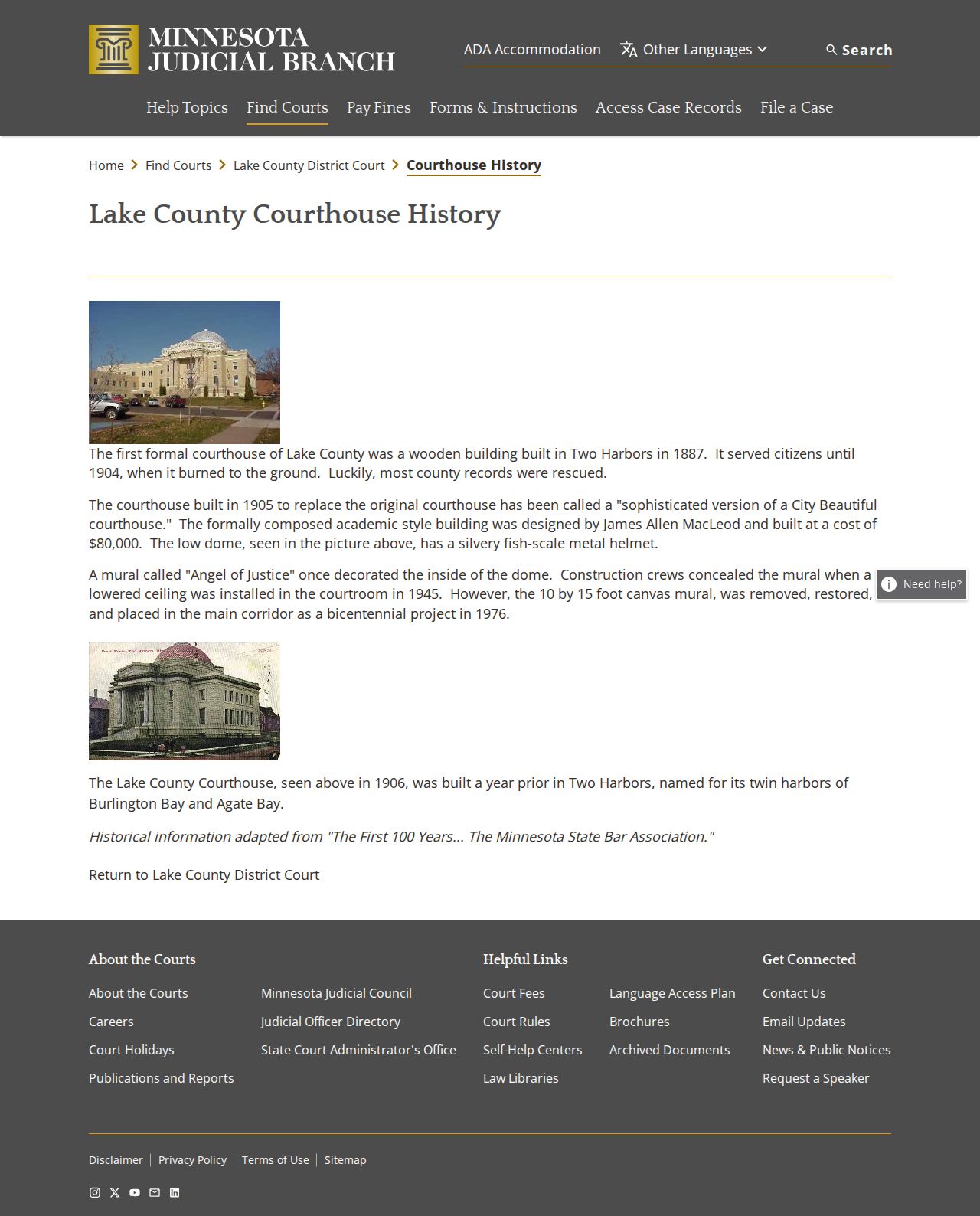
That historic Lake County courthouse now sits beside MCRO, electronic filings, PDF calendars, and controlled public terminal access.
Lake Court Docket Technology Layers
Picture Lake County court dockets as a stack of tools. Each tool has its own job. MCRO handles public docket searches. A terminal at the courthouse opens a wider public view. The daily PDF calendar is just a schedule snapshot for that day. Then there is Minnesota eFile and eServe, called eFS. It exists for lawyers and other required filers to file and serve papers; it is not a public case lookup. So even after a filing moves through eFS, an eligible public MCRO record may not appear right away. Who must file electronically? Which charging documents are exempt? Minnesota’s district-court filing guidance spells out the eFS requirements on both points.
One more layer deserves a caution. The Judicial Branch statistics portal publishes aggregate court data dashboards and downloads, not individual Lake County case records. Its Sixth District figures cover many counties. Relabeling those numbers as Lake County counts would mislead. That holds unless a verified county filter is applied.
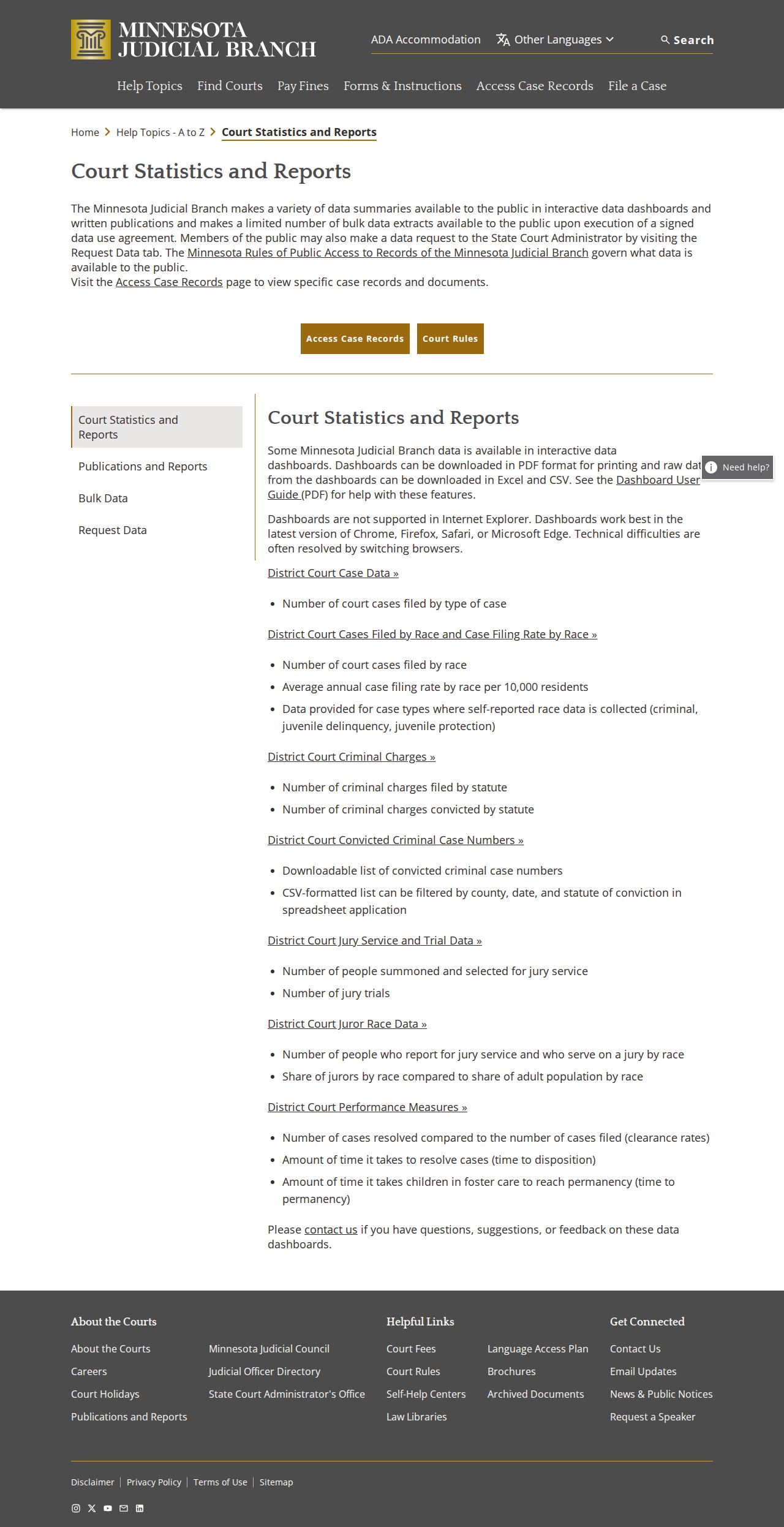
Aggregate numbers describe workload. They cannot replace the Lake County docket for one specific case, because dashboards count filings while a docket tracks what happened inside a single file.
Lake County State and Federal Records
Some Lake County matters end up in federal court instead. Federal civil, criminal, bankruptcy, and appellate cases sit outside Minnesota District Court entirely. PACER is the official public-access service for them. The U.S. District Court for the District of Minnesota and the federal bankruptcy court each run their own access systems. A federal search never appears in an MCRO result.
So keep the case numbers straight. Use the state case number for a Lake County district-court matter. Use the federal case number plus its court for PACER. CourtListener helps locate contributed federal materials. It is not a complete substitute for the official federal record. The District of Minnesota is the official federal district-court source for Minnesota federal matters. Confirm the right system before requesting records. That keeps your conclusions clean.
Keep the two routes separate. Lake County court research stays accurate when the state District Court route is not confused with a federal docket route, since each system holds different cases.
Lake County Court Dockets by City
Only three cities in Lake County are incorporated: Two Harbors, Silver Bay, and Beaver Bay. None of them runs its own trial-court docket portal. Court-filed city matters route to Lake County District Court. An administrative city-code citation, though, can stay a city matter. Each city page keeps that distinction clear. It points court-file questions toward Lake County Court Administration.
Two Harbors Docket Search
2020 Census population: 7,024. The county-seat courthouse is the Lake County court-record access point.
Silver Bay Docket Search
2020 Census population: 1,857. City-code or police contacts are separate from a district-court record.
Beaver Bay Docket Search
2020 Census population: 120. Use the Lake County route for a state court case.
A city administrative matter needs only the citation or notice. A court file is different. Search MCRO first, check the Lake calendar where appropriate, and contact Court Administration for an official record.
Map and Directions to the Lake County Courthouse
Lake County Court Administration keeps the District Court's civil, family, probate, juvenile, criminal, and traffic files at the Lake County Courthouse, 601 Third Avenue, in Two Harbors. The courthouse also hosts a public-access court-record computer, which the Judicial Branch says is generally the most complete public electronic view of a case, broader than what remote MCRO can show. The Lake County Attorney's office shares the same address but is a separate, non-neutral office from Court Administration.
Lake County Court Administration
Lake County Courthouse
601 Third Avenue
Two Harbors, MN 55616
218-595-5001
Monday through Friday, 8:00 a.m. to 4:30 p.m.
The court page describes free surface-lot and on-street parking. No published security-screening or ADA-entrance detail was located for this courthouse, so calling Court Administration ahead of a records trip is the safer plan.