
Searching Lake County Criminal Dockets
Start remotely with Minnesota Court Records Online (MCRO) Case Search, which covers available Lake County criminal cases. Got a case number? Use it first. Without one, pick Lake County and the Criminal category, then check the case category, filed date, court location, party role, and charge count before you trust a match. The system accepts exact names or a trailing wildcard. A wildcard will not combine with the Sounds Like option.
Keep MCRO's limits in mind. It is not the official court record. A name search can miss a pending criminal case with no conviction, while a case-number search may still return a record. When you want a public document, take that known case number to Document Search. If nothing comes back remotely, try the courthouse public-access computer or Lake County Court Administration rather than assuming no record exists.
- Open MCRO Case Search and select Lake County before executing a name, case-number, citation-number, or attorney search.
- Match the case number, category, filed date, location, and party role, then open Case Details, Minnesota’s Register of Actions.
- Use MCRO Document Search only with a known case number and only for a document that is publicly available remotely.
- For a scheduled hearing, compare MCRO Hearing Search with the Lake daily calendar and confirm an important setting with Court Administration.
- When remote access is incomplete, inspect the public terminal, call or visit Court Administration, or request an authorized copy through the local process.
Note: The citation number printed on a ticket may not match the MNCIS case number the court record later uses.
Lake County Criminal Search Fields
The MCRO search screen splits its queries into Name, Case Number, Citation Number, and Attorney searches. Picking a county only narrows things. It does not run a search by itself. A focused Lake County query trims stray statewide name matches, yet it still cannot prove that a same-name result is your person. The public terms warn that names make poor identifiers. A case type, likewise, says nothing about the outcome.
| MCRO field | Lake criminal use |
|---|---|
| Case Number | Best starting point when known; it may locate an available record that a remote name search does not show. |
| Name | Use exact spelling or a trailing wildcard after at least two characters, with Lake County selected. |
| Case Category | Select Criminal when the search concerns a criminal court case rather than civil, family, probate, or mental-health categories. |
| Date Filed | Use an exact date or date range to distinguish similar Lake County results. |
| Court Location | Choose a specific county and execute the county search before reading results. |
The MCRO Case Search source lays out the name, case, citation, and attorney controls available for a Lake County criminal docket search.
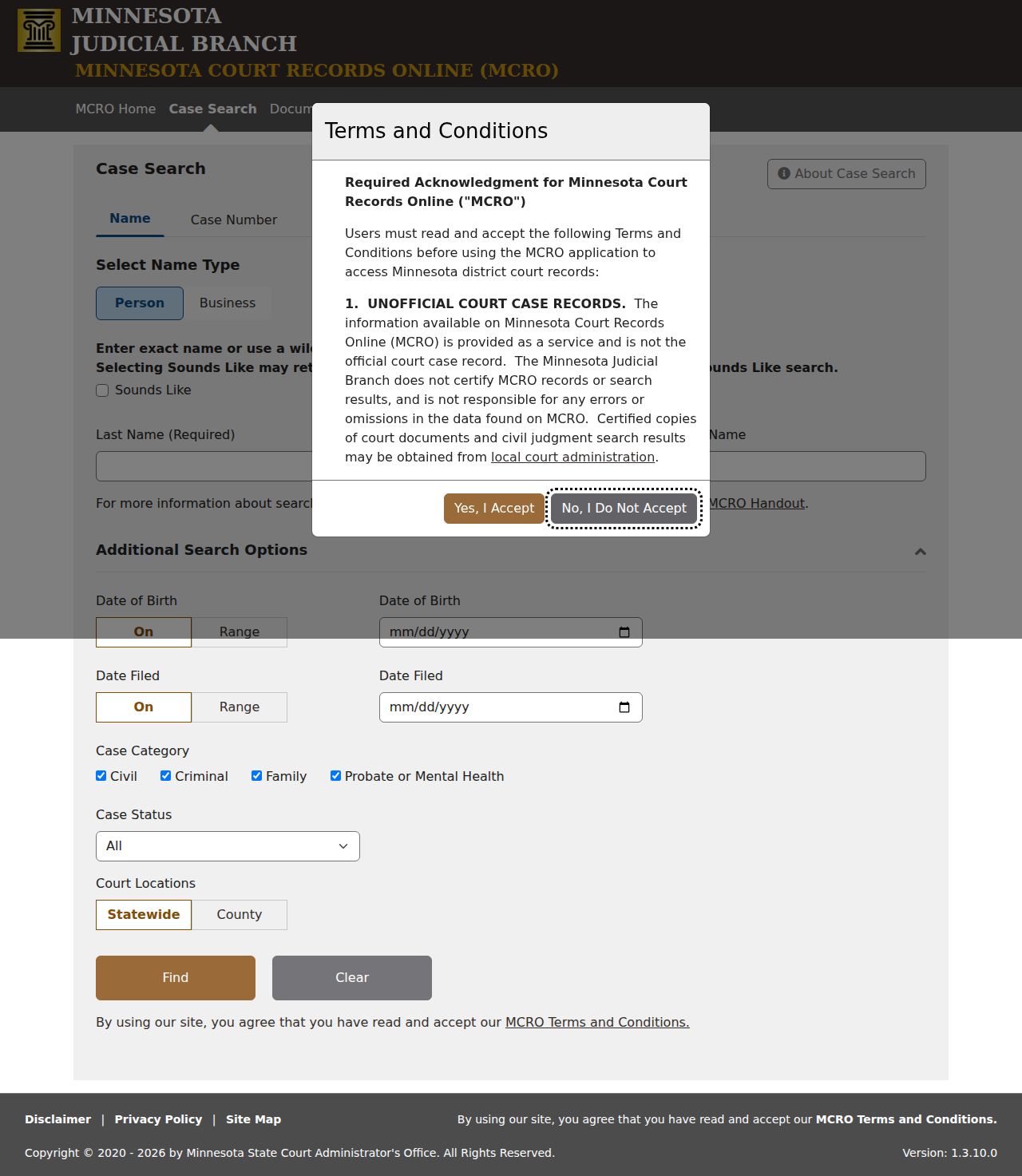
Those controls narrow the hunt. To learn what a matched result truly means, turn to the Register of Actions or the court where the case began.
Inside a Lake County Criminal Docket
Minnesota calls the docket the Register of Actions. Rule 8 defines it as the title, origination, activities, proceedings, and filings in a case. Within a Lake County criminal entry you may see the case number, the parties, the filing location, a charge or offense label, hearing settings, orders, disposition, sentence, fines, and other events. Each short description is procedural shorthand. It is not the evidence, nor an account of why the judge acted.
A criminal case number can take a form like 16-CR-26-00000. Here the CR segment signals a criminal case type, but the actual record controls. Remember the basics. A charge is an allegation. An arraignment or first appearance is just a setting. Read a disposition charge by charge, since a later sentence or order can shift a case's practical status.
| Case number | The court identifier linking the Lake County case, filings, hearings, and any copy request. |
|---|---|
| Case caption and parties | Procedural names and roles, not proof of an allegation or result. |
| Charge and event history | Filed charge labels and dated steps such as a first appearance, arraignment, omnibus hearing, or motion hearing. |
| Hearing setting | A scheduled proceeding and its date, not a record that the hearing occurred or an outcome. |
| Disposition and sentence | Separate entries that should be read with later orders and the charge-specific record. |
Lake County Criminal Docket Labels
The Lake County calendar uses familiar criminal labels: First Appearance, Arraignment, Pre-trial, Omnibus Hearing, Motion Hearing, and Review Hearing. Each one names a kind of court setting. That is all it does. A label will not tell you what was argued, what evidence came in, or whether the matter resolved. The Register of Actions may later add a continuance, an order, a disposition, or another event. Detail can still require pulling the document itself.
- First Appearance
- An initial criminal proceeding label observed on the Lake calendar.
- Arraignment
- A setting generally associated with a formal response to a charge; the docket and governing law control its meaning in a case.
- Omnibus Hearing
- A criminal-procedure hearing label whose purpose and result require the actual case entries and orders.
- Disposition
- The recorded resolution or status of a charge or case. It is not automatically the same as a trial verdict.
- Warrant indicator
- A legacy terminal indicator that must be confirmed with the court and is not a real-time warrant status.
Note: A "continued" entry only means the setting moved. It does not say why, or who asked.
How a Criminal Case Moves
A Lake County criminal Register of Actions traces a procedural path. It is not a tidy story. Charges, motions, negotiations, and court orders all shape the route. So read the dated entries in order. A calendar label or the word "closed" is never the whole account. Hearings get rescheduled. An order can land on a later date than the hearing it follows.
Criminal process: Filing or charge → First appearance or arraignment → Pre-trial or omnibus setting → Motion, plea, or trial activity → Disposition → Sentence or later order.
Public charging information is an allegation. A final disposition and a sentence are separate entries, not one event. If an appeal is pending, the Lake County district-court case stays the starting record, and review runs through the Minnesota court system's Sixth Judicial District information and the Minnesota Court of Appeals.
Lake County Criminal Terminal Access
The Lake County District Court listing confirms a public-access court-record computer at the local courthouse. Courthouse terminals can provide a broader public view than remote access. Local paper records may also require counter access. Lake County Court Administration is the correct local record keeper for a question about a court file, a certified copy, or a record that is not available through MCRO.
Minnesota eFile and eServe, commonly called eFS, is different from a public docket lookup. Required filers use it to file and serve materials within the court system. It does not replace MCRO’s public search function, and receiving a document through eFS does not make every document remotely public.
The statewide eFS source describes the filing system that can place new material into a Lake County criminal case.
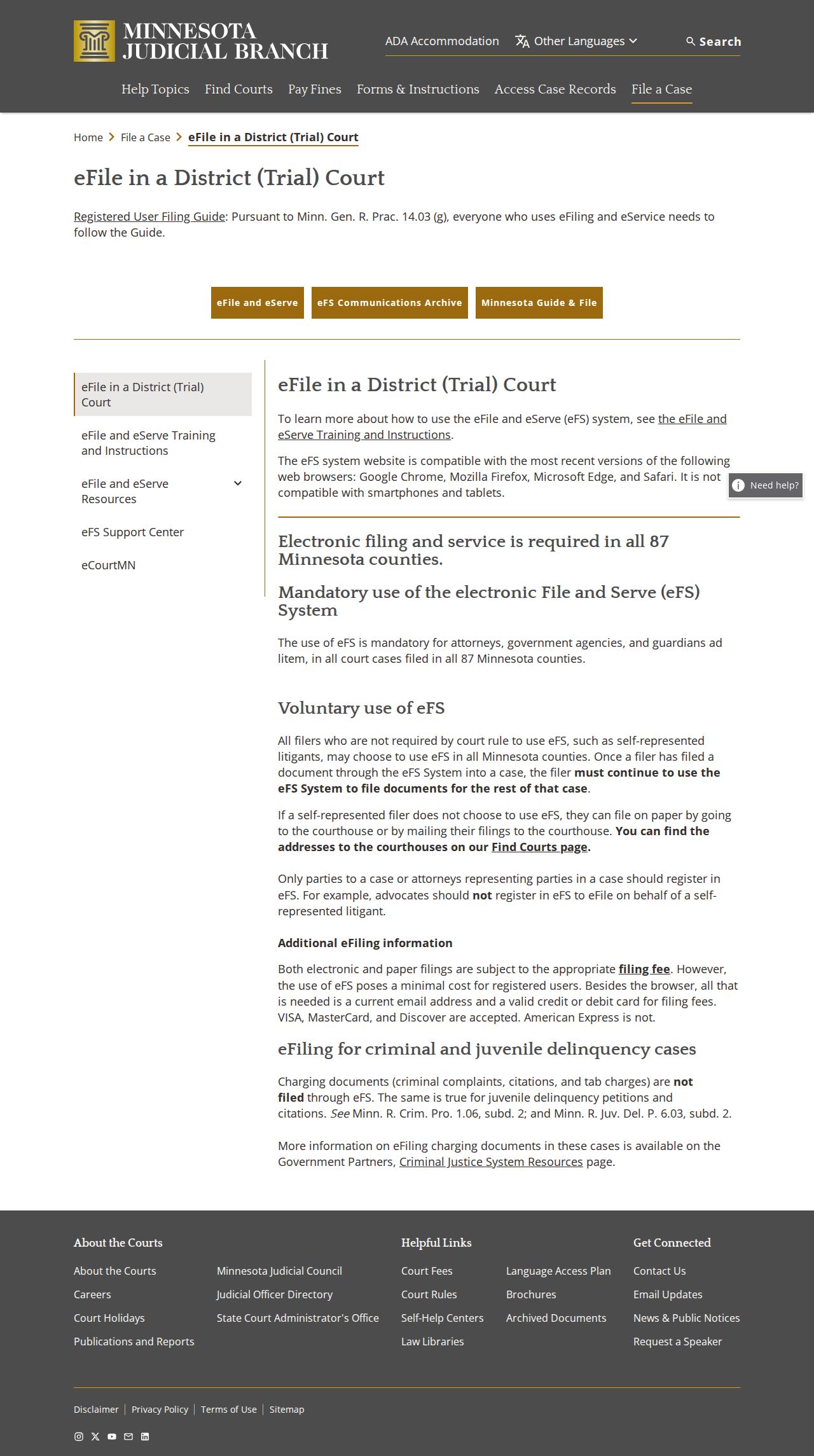
Filing access and public docket access follow separate rules. So do not expect the eFS screen to work as a criminal Register of Actions for Lake County.
Courts That Hold Criminal Dockets
The office to contact is Lake County Court Administration. Ask for the Court Administrator. Lake County criminal cases are heard by Lake County District Court. It is part of Minnesota's unified district-court system. There is no separate Lake County superior court and no standalone municipal trial-court clerk.
Lake County sits in the Sixth Judicial District alongside Carlton, Cook, and St. Louis Counties. District administration supports the courts. It does not itself hear a Lake case. Criminal, civil, family, probate, juvenile, traffic, and ordinance cases all begin in the district-court structure. Federal criminal charges stay in the federal court system. They never appear in MCRO.
The court listing shows which court holds original jurisdiction and how to reach it locally. Court Administration is the neutral source for local court-record access. The county attorney, sheriff, police department, or a commercial service is not.
Lake County Criminal Case Number Checks
A Lake County criminal case number does more than speed up a search. It ties together MCRO Case Search, the Register of Actions, Document Search, Hearing Search, the courthouse terminal, and a records request to Court Administration. That matters most for a pending criminal record with no conviction. Such a record cannot be searched remotely by name. Searching the number can surface an available record the name route never shows.
Check the number against the court location, the filed date, and the case category. Also check the party role. A CR type is a helpful hint of a criminal case. Reading the actual case detail still settles the question. A citation number is a different identifier. A traffic matter can carry a different posture. When a number returns nothing, Court Administration can sort out the access channel without disclosing restricted material.
Lake County Criminal Document Access
A Register of Actions is not the whole file. With a case number in hand, MCRO Document Search offers a case-number-first route to documents that may be online. The state's MCRO information says documents filed on or after July 1, 2015 are generally available for major and minor criminal cases. Rule-based exceptions apply. Even so, a complaint, order, or judgment can still be unavailable remotely.
For a full public record or a certified copy, go through Lake County Court Administration. Use the official Sixth District copy-request process. A courthouse terminal can display more public information than a remote search. Do not republish birth dates, home addresses, victim or witness details, juror data, financial fields, juvenile information, or allegations. Go no further than understanding one official record requires.
Note: The smallest relevant public record is often the safest way to answer a procedural question without treating a docket entry as a complete narrative.
Sealed Dockets and Public Access
Minnesota Rule of Public Access Rule 8 sets the basic access framework for Lake County criminal records. It covers inspection and copying of accessible originals. That happens at the normal place of access during regular hours. The rule also draws separate boundaries for registers, calendars, indexes, judgment dockets, and documents. The key word is "accessible." A record open at the courthouse may not be searchable remotely at all.
Lake County access rule. Minn. Stat. § 13.90 excludes the judiciary from the Minnesota Government Data Practices Act and directs court-record access to Supreme Court rules.
Rule 8 limits remote name searching for pending criminal matters without a conviction and protects specified personal information.
Rule 4 addresses restrictions imposed by court order and distinguishes an official transcript from supporting recordings.
The Rule 8 source sets the access limits that can leave a Lake County criminal docket visible at the courthouse yet narrower online.

Sealed, restricted, juvenile, victim, witness, and protected identifying information call for extra care. An empty result does not prove a case never existed. A remote result never substitutes for the originating court record.