
Getting Lake County Court Records
Court Administration handles Lake County's civil, family, probate, juvenile, criminal, traffic, conciliation, and judgment records. These belong to the Minnesota District Court. The fastest start is Minnesota Court Records Online, known as MCRO. That is where the public case record lives. Already have the case number and a public filing in mind? MCRO Document Search is the right tool. For the fullest electronic view, visit the terminal inside the Lake County courthouse instead. Plain, certified, and exemplified copies all come by request from Court Administration. Each access route plays its own part. The public terminal, the counter, and the mail form each cover one piece. Phone contact, fax, and eligible email delivery handle the rest.
- Locate the Lake County case number. If it is unknown, search MCRO by name and county, or provide a party name and filing year on the copy request.
- Name the document or describe it, then choose plain, certified, exemplified, or certified/exemplified status as needed.
- Use MCRO for remote public material, visit the Lake County terminal or counter for courthouse access, or submit the Sixth District copy form by mail, fax, or eligible email.
- Include the payment requested by Court Administration before processing and select mail, Two Harbors pickup, fax, or email delivery where allowed.
- Confirm the document is public and the current charge before relying on a copy for a formal purpose.
Direct your questions to Lake County Court Administration itself. The county attorney and private records sellers are not the right doors. For phone help, call 218-595-5001. If a local procedure shifts, the Court Administration page and the current form govern.
Lake County Court Record Layers
A Lake County court record is not one thing. The Register of Actions gives the event-by-event history, while the daily calendar is a separate, forward-looking hearing schedule. Where access rules permit, public documents include complaints, answers, motions, orders, and judgments. The courthouse terminal can display a broader electronic view than any remote search, yet some material still sits in a paper file or needs staff help to reach. Certified and exemplified copies are authenticated outputs, and a transcript, the official written record of a proceeding, follows its own separate process. Knowing which layer you need prevents a half-finished request. Want the hearing date? Check the calendar or Register of Actions. Want the signed ruling? Name the order or judgment. Need proof the copy is authentic? Ask Lake County Court Administration whether certification or exemplification applies. One caution: an online screen print is not automatically a certified court record.
Court Record Types
Lake County District Court records span several case families. Each one carries its own public-access boundary. A Lake County search result may give you the register without every document attached. What shows up remotely also depends on the record type and the document date. Court Administration can confirm whether a specific Lake County document is available. It cannot give legal advice. That limit extends to how a record should be used.
- Register of Actions entries and public hearing-calendar information.
- Public criminal, civil, probate, guardianship, conservatorship, and trust documents where remote access is allowed.
- Orders, judgments, and notices prepared by the court.
- Traffic, conciliation, and judgment records kept within the Lake County district-court system.
- Plain, certified, or exemplified copies supplied by Lake County Court Administration.
Family records need extra care. Court-prepared orders, judgments, opinions, and notices are treated differently from party-submitted family documents in remote access. A Lake County record can be public at the courthouse yet unavailable as a remote PDF.
Lake County Court Record Copies
The Sixth District's official copy-request form collects the basics. It asks for requester name, phone, address, city, state, ZIP, and email. Then it asks for the county location and the court file number or year. Party names, the document you want, your certification choice, the number of copies, and the delivery method come after that. One wrinkle worth knowing: file numbers are available online only for files after 1991. A Lake County requester without a number should include the year when it is known. Mail the request to Lake County Court Administration. Use Attn: 6th District Copy Center, 601 3rd Ave, Two Harbors, MN 55616. Delivery runs through U.S. mail, Lake County pickup in Two Harbors, fax, or email. Email is limited to plain, non-confidential copies. Include payment up front. Processing waits on it. Staff may call if payment is missing. Per the form's direction, make checks or money orders payable to the Court Administrator. Note: Send only what identifies the Lake County record. Leave out Social Security numbers, bank-account numbers, and other sensitive details.
Inside a Lake County Court Record
Case Details in MCRO displays the Lake County Register of Actions. Minnesota keeps this chronological procedural record on each case. Expect the case number, caption, category, and filing date. Party roles, judicial officer, hearings, events, orders, judgments, and disposition entries appear as well. A short entry, though, does not always carry the full content of the filing it names. A motion hearing entry, for instance, will not tell you the issue or the ruling unless the motion and the order are accessible too.
| Case number | The court identifier that ties Lake County filings, hearings, and copy requests together. |
|---|---|
| Caption and parties | The procedural title and roles. A party name or label is not a finding of fact. |
| Register of Actions | The chronological activities, proceedings, and filings that form the procedural history. |
| Documents | Public pleadings, motions, orders, judgments, or other filings available under the rules. |
| Hearing information | Scheduled settings, judicial officer, and related public calendar information. |
| Disposition or judgment | Recorded resolution information that should be read with the underlying order and later entries. |
When requesting a Lake County copy, pair the case number with the document title. That works far better. A broad file under a common name alone will not do the job. Searching first? Try the contextual Lake County case lookup route before you make the request.
Lake County Court Record Documents
Wondering which Lake County filings you can actually pull up from home? MCRO puts documents filed on or after July 1, 2015 online in most major and minor criminal and civil cases. Formal and other probate, guardianship, conservatorship, and trust cases are covered too. All under the Rules of Public Access. A smaller set may also be reachable remotely. These are court-generated documents from July 1, 2005 through June 30, 2015. Even so, what a Lake County docket search returns still hinges on the case type, the document's date, and any restriction or redaction attached to it.
Don't confuse MCRO with Minnesota eFile and eServe, known as eFS. That statewide platform handles filing and service for required filers, not public record searching. Citations and criminal complaints follow separate filing treatment. A document may sit in an eFS case file. That does not make it automatically viewable by the public through MCRO.
Fees and Certified Copies
Plain copies and certified records sit in different tiers of the Lake County fee schedule. A certified copy is one that Court Administration has authenticated as a true court record. One step up is the exemplified copy. It is a more formal authentication package that another jurisdiction may demand. Ask which level you need before you pay. A screen print, a remote PDF, or any ordinary plain copy carries no certification at all.
| Lake County record item | Listed fee | Request note |
|---|---|---|
| Plain uncertified copy, printout, scan, or screen print | $0 | Availability still depends on public-access rules. |
| Certified copy or certified printout | $14 | Generally listed for the item requested. |
| Certified or exemplified copy | $28 | Ask whether the receiving office requires this level. |
| Exemplified or uncertified copy | $14 | Listed separately on the Lake County schedule. |
| Scanning | $25 per 50 pages or part | Confirm the page count before payment. |
| Report, 1 to 50 pages | $5 | Reports above that threshold are listed at $25 per 50 pages or part. |
| Certified judgment search | $5 listed | The fee page contains conflicting calculation text, so verify the total with Court Administration. |
For current amounts, the live Lake County district-court fee schedule controls, since fees, forms, and delivery methods can change.
Lake County Court Administration
Attn: 6th District Copy Center
601 3rd Ave
Two Harbors, MN 55616
218-595-5001
Lake County Federal Record Boundary
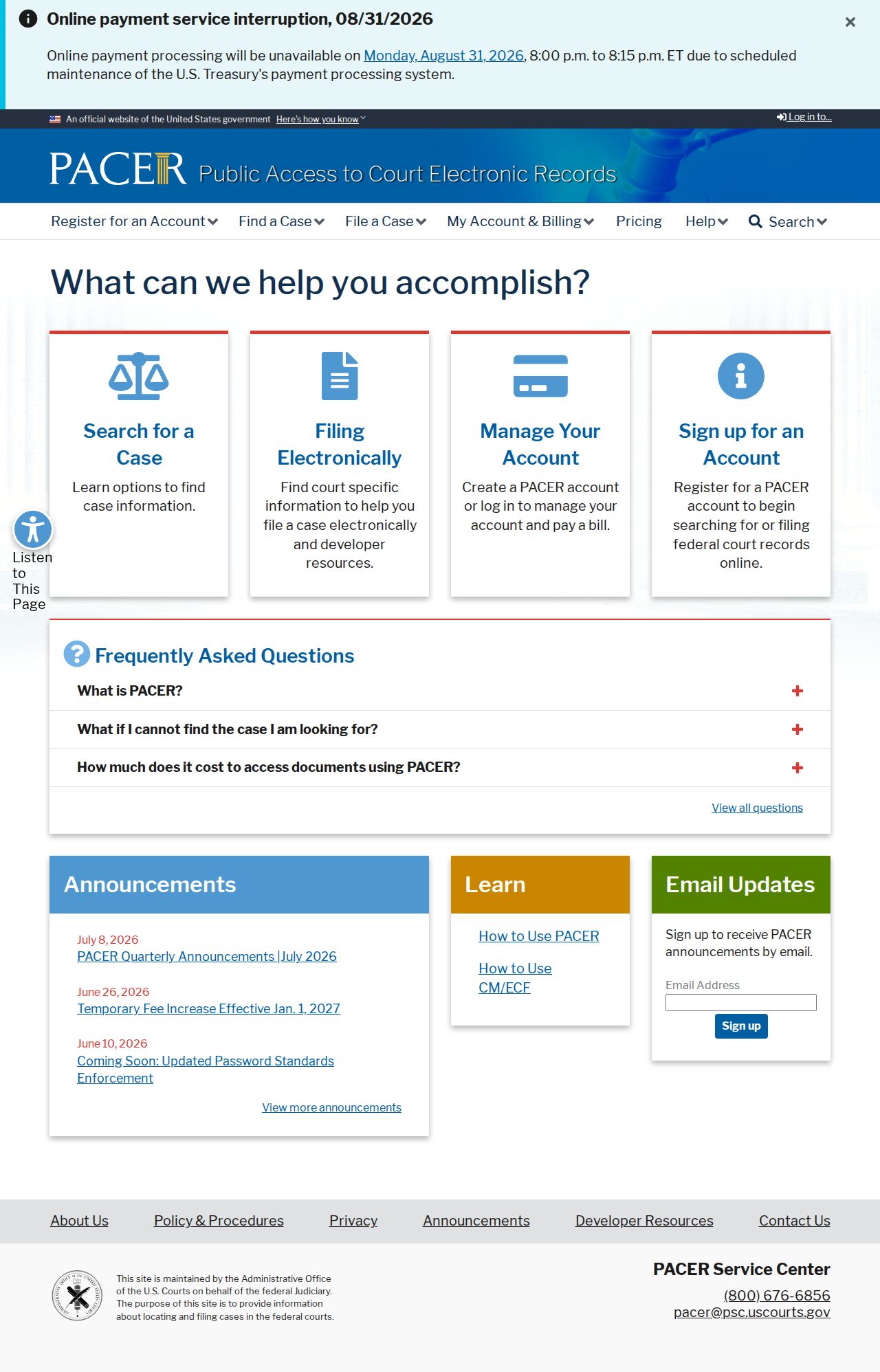
State court and federal court are two different worlds in Lake County. A federal case can involve a Lake County person, business, federal question, bankruptcy, or federal criminal charge. It will never appear in MCRO. The official federal route is PACER. It searches a national index or any single federal court. PACER is the official source, so check its current fee rules before a large retrieval.
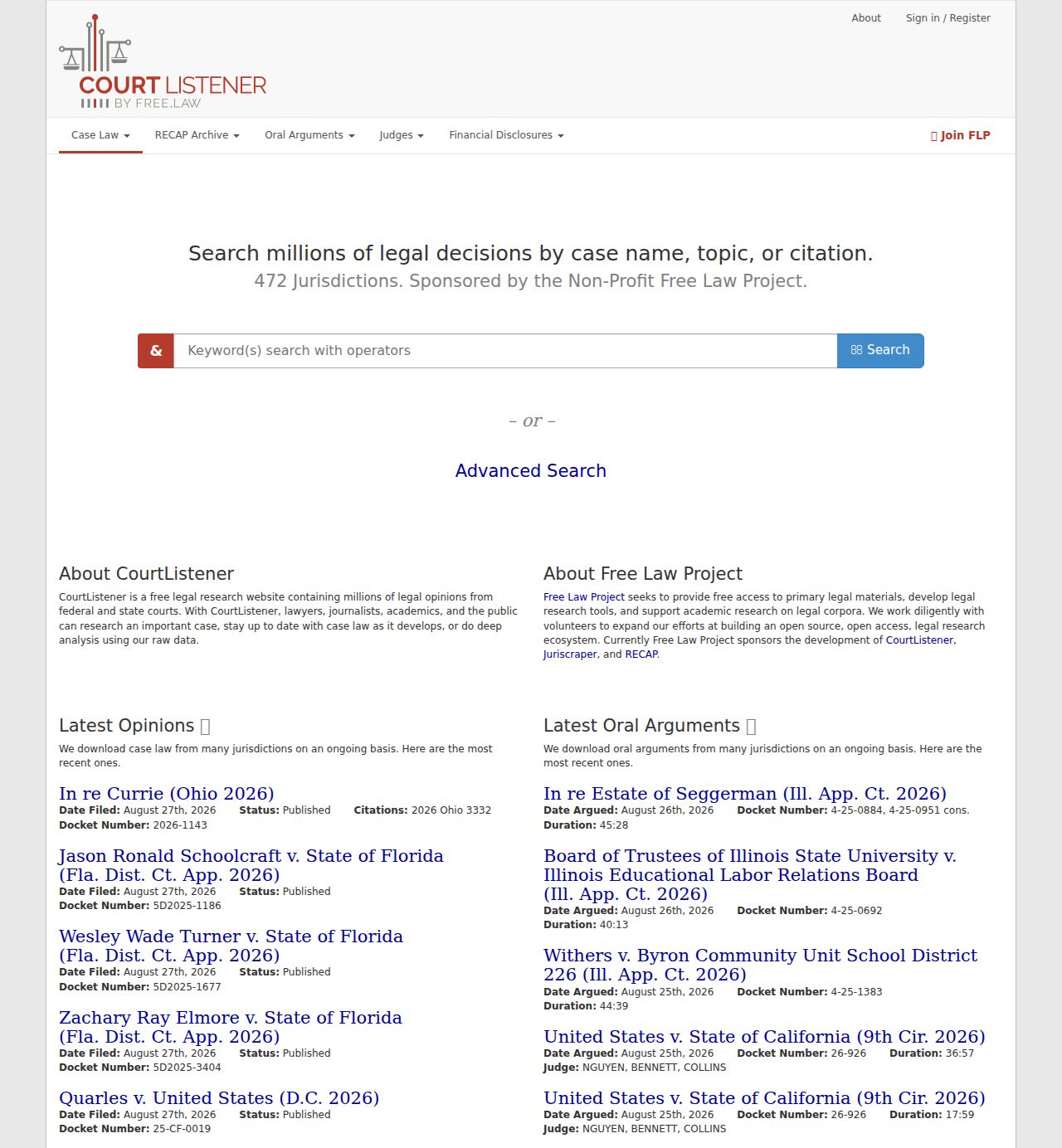
A federal docket keeps its own custodians. Its access limits apply even when the events unfolded in Lake County. The state case file, meanwhile, stays with Lake County Court Administration and the Minnesota Judicial Branch. For a free assist, CourtListener and RECAP can surface many contributed federal docket entries. It can't replace PACER's official record. Coverage may be incomplete. When you need an official federal copy, go to the court or PACER.
Keeping the two systems straight protects a Lake County record request from landing in the wrong court.
Sealed Records and Public Access
Public access to Lake County court records runs through Minnesota court rules. It does not run through a county-wide public-data request process. Minnesota Statutes section 13.90 governs here. Judiciary records answer to Supreme Court rules instead of the Minnesota Government Data Practices Act. Rule 8 allows inspection and copying of accessible records at the normal place of access during regular hours. It also draws different remote-access lines for registers, calendars, indexes, judgment dockets, and documents. So a Lake County record can be public at the courthouse. It may still be missing from MCRO entirely.
Access rules: Minnesota Rule of Public Access 8 sets the public-access and remote-access framework. Rule 4 governs court-ordered restrictions and distinguishes official transcripts from supporting recordings. Minn. Stat. §13.90 directs court-record access to the Supreme Court rules.
Protected identifiers cover a lot of ground. They include Social Security numbers, employer identification numbers, street addresses, telephone numbers, and financial-account information. Details identifying jurors, witnesses, and victims are shielded too. Orders for protection, harassment, child-protection, certain juvenile, and sensitive family materials carry their own special boundaries. One caution: if something is absent from a remote search, that alone proves nothing. A Lake County case can exist, unsealed, and still not show up online.
Lake County Courthouse Records
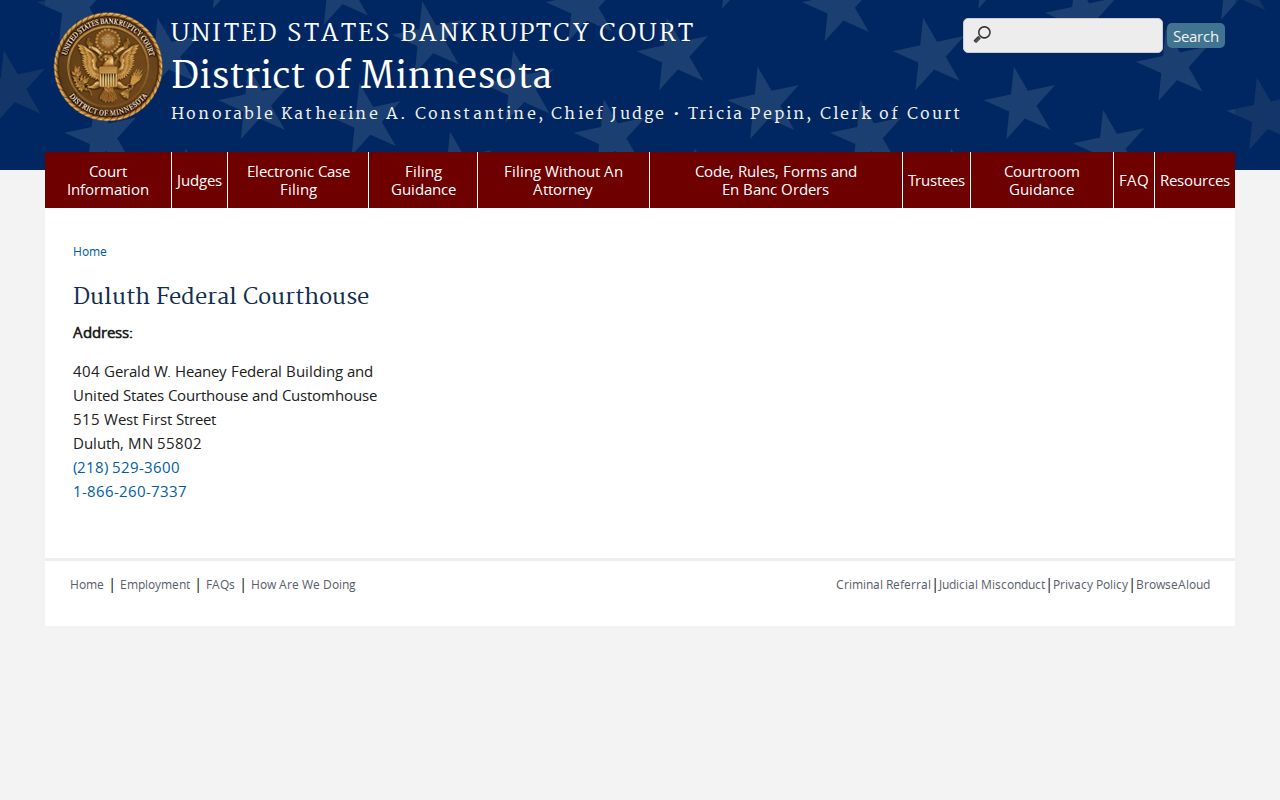
Inside the Lake County courthouse sits a public-access computer. Courthouse electronic terminals generally offer the widest public electronic view of the court docket. Some local paper records still demand counter access. That makes the courthouse a practical fallback whenever MCRO lacks a public document, the file is older, or staff help is needed to sort out the right copy process. One caution on addresses: the official Duluth Federal Courthouse handles District of Minnesota bankruptcy matters. It is not a Lake County state-court records counter. It appears here only to keep the federal and Lake County routes clearly separate.
For a Lake County District Court record, start with MCRO or Lake County Court Administration rather than a federal courthouse.
Note: A transcript follows a separate process, because the transcript, not any audio or video recording, is the official text of a proceeding.